

Geopolitics in Motion: External Interventions in the Horn of Africa (HoA) and the Escalation of Conflict in Sudan
The Horn of Africa (HoA) occupies a pivotal position in global geopolitics and geoeconomics due to its proximity to critical maritime checkpoints and passways such as the Bab el-Mandab Strait and the Suez Canal, which connect the Middle East and Europe. Situated along the Red Sea, the Gulf of Aden, and the Indian Ocean, the region is widely regarded as one of the most geo-strategically significant areas in the world. This strategic importance simultaneously offered comparative political advantages while also proven to be a liability, drawing persistent foreign interventions destabilizing the region. Historically, the region’s littoral along the Red Sea and Indian ocean and wealth of natural resources—including precious metals—made it a theater of superpower rivalry during the Cold War. Its proximity to the heavily militarized and contested Middle East also further shapes the region’s political trajectory and foreign policy orientation.
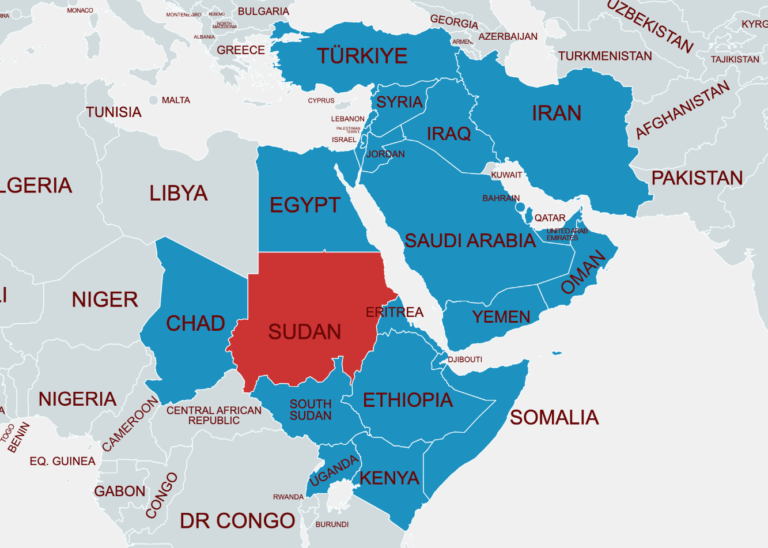
The sectarian divide between Shia and Sunni, the Houthi–Saudi/United Arab Emirates (UAE) conflict in Yemen, the rivalry between Qatar and the Saudi–Emirati coalition, and the broader Arab–Israeli tensions have all profoundly influenced the HoA’s political dynamics. These rivalries have fueled and prolonged conflicts, while simultaneously shaping the diplomatic alignments of states in the region. Recent developments illustrate this influence: Israel’s recognition of Somaliland and the fragmented interventions of Middle Eastern states in Sudan’s civil war highlight the extension of Middle Eastern rivalries into the Horn. Primarily precipitated by the conflict between the Sudanese Armed Forces (SAF) and the Rapid Support Forces (RSF), Sudan, in particular, has currently emerged as an active stage of hegemonic competition among regional powers.
Its proximity to the heavily militarized and contested Middle East also further shapes the region’s political trajectory and foreign policy orientation.
Once credited as Africa’s “breadbasket” and envisioned as a potential “promised land” due to its geography, natural resources, and strategic location, Sudan now faces a devastating political crisis. The ongoing civil war between state and quasi-state forces has reached unprecedented levels of destruction, displacement, and loss of life, surpassing even the conflicts surrounding South Sudan’s independence. Initially defined by the confrontation between SAF and RSF, the conflict has expanded to involve domestic actors, including the Sudan People’s Liberation Movement–North (SPLM-N) under Abdelaziz Adam Al Hilu and the Sudan Liberation Movement/Army led by Abdul Wahid Al Nur (SLM/AW). Yet, as with many African conflicts, external involvement has been decisive in shaping its trajectory.
Unlike earlier African wars that drew interventions from global superpowers such as the United States, Russia, and China, Sudan has become a stage for the rivalries of emerging Middle Eastern powers, including Iran, Saudi Arabia, Turkey, and the UAE. These states, often working through proxy alliances with neighboring countries, have become principal enablers of Sudan’s conflict actors. By backing opposing sides, they have employed diverse tactics to influence Sudan’s political future, prolonging the conflict and reshaping the regional security landscape. This shift from traditional superpower involvement to a growing rivalry among mid-level regional powers marks a new phase in the geopolitics of conflicts in Africa.
This shift from traditional superpower involvement to a growing rivalry among mid-level regional powers marks a new phase in the geopolitics of conflicts in Africa.
Consequently, what began as an internal power struggle between SAF and RSF has evolved into a multi-actor regional conflict, undermining Sudan’s territorial integrity. While public discourse, the media, and other political discussions often focus on the question of “who supports whom,” the deeper issue of “why alliances are established and exist” remains blurred. This article aims to describe and analyze this issue.
Collectively, the evolving nature of external intervention in the HoA, shifting from global superpowers to emerging Middle Eastern states, is attributed not only to the region’s relative geographical proximity to the Middle East but also to deep-rooted religious and linguistic ties. Islam serves as a spiritual bond linking the HoA with the Middle East, while linguistic connections further reinforce this relationship. However, the ultimate driver of their interventions is found to be national interest.
The most prominent external actor in the Sudanese conflict is the UAE. The Sudanese government under General Al Burhan has accused the UAE before international courts of supporting the RSF, including alleged ‘genocide’ against the Masalit community in West Darfur, an allegation which is also shared by the US government. Reports from international organizations, human rights groups, and Western intelligence agencies further document extensive Emirati military and financial assistance to the RSF. Reports indicate that this support has moved through complex regional networks involving Libya, Chad, Uganda, and parts of Somalia.
Three interrelated interests drive the UAE’s involvement in Sudan. First, Sudan has long served as a source of mercenaries for the Emirati-led war in Yemen, where tens of thousands of Sudanese fighters have been deployed since 2015. In 2016, the RSF, under a separate agreement with the UAE, dispatched a contingent that operated independently from the SAF, laying the foundation for their current institutional rivalry. Sudan contributed an estimated 7,000 to 15,000 troops to the coalition, making it the largest ground force contribution, with some troops under the SAF and others under the RSF, under separate commands. Extending these ties, the RSF leader Hemedti pledged 4,000 fighters to Libya in 2019 and deployed 1,000 troops to support General Khalifa Haftar, a faction backed by the UAE.
Second, the UAE has significant economic interests in Sudan’s land, gold, and ports. Gold exports facilitated through RSF-linked networks are particularly vital to Dubai’s role as a global gold trading hub. Emirati firms also control large-scale agricultural projects, while Dubai’s DP World has pursued strategic investments in Sudan’s Red Sea ports.
Third, ideological considerations also shape the UAE’s intervention in Sudan. Unlike the majority of regimes in the Middle East that derive legitimacy from religious authorities, the UAE’s ruling families base their power on historical, tribal, and material foundations, widely positioning themselves as hostile to political Islam. Its leadership views militant Islamism as an existential threat and has a foreign policy orientation of supporting efforts to suppress Islamist movements and backing non-Islamist actors in fragile states. Since the Arab Uprisings of 2011 revealed the transnational appeal of Islamist ideologies, the UAE has invested heavily in countering political Islam regionally and domestically. These ideological orientations have led the UAE to favor the RSF over the SAF, whose institutional legacy is closely associated with Islamist networks from the Al-Bashir era and has been further reinforced by Burhan’s January 2024 visit to Tehran, which further reinforced his identification with Islamist groups both domestically and globally.
Since the Arab Uprisings of 2011 revealed the transnational appeal of Islamist ideologies, the UAE has invested heavily in countering political Islam regionally and domestically.
Sudan has also emerged as a proxy arena for wider regional rivalries. As strategic competition intensifies in the Red Sea and the HoA, particularly between the UAE and Saudi Arabia amid shifting U.S. regional priorities, Sudan has become a site for power projection. This rivalry was already evident in Yemen, where the two Gulf states backed opposing forces, but the rupture extends well beyond that conflict. What was once a closely coordinated Gulf partnership has evolved into a broader geopolitical competition spanning the Middle East, Africa, and the Red Sea corridor. The UAE’s deepening strategic alignment with Israel has further widened the rift with Riyadh. In this context, Emirati support for the RSF and Saudi backing of the SAF reflect not only Sudan’s internal divisions but also larger regional realignments and competing visions of order in the Red Sea region.
Egypt also emerged as a key external actor in Sudan’s civil war, viewing stability along its southern border and the Nile as vital to its national interests. Despite sustained diplomatic engagement, Cairo faces the dilemma of maintaining neutrality or openly supporting one conflict actor. For a variety of reasons, including the SAF’s comparative dominance over national institutions, in contrast to the RSF’s tribal base with limited institutional integration, Egypt leaned toward supporting the SAF while being wary of its Islamic tendencies, which Al-Sisi’s government vehemently opposes. Reflecting its position, in September 2025, Foreign Minister Badr Abdelatty emphasized the importance of distinguishing Sudan’s national army from other armed groups and reaffirmed Egypt’s commitment to strengthening its institutional capabilities.
Most recently, on 12 February 2026, Egypt leveraged its chairmanship of the African Union Peace and Security Council (AU PSC) to place Sudan at the forefront of the Council’s discussion. Cairo sidelining other pressing continental issues including Israel’s recognition of Somaliland, Ethiopia’s internal strife and rising tensions with Eritrea, instability in the Democratic Republic of Congo, and the resurgence of Islamist fundamentalism in Nigeria, undertook a good diplomatic effort to reassert the urgency of Sudan’s crisis in the Union’s security operations and argued in favor of its re-admission to the Union.
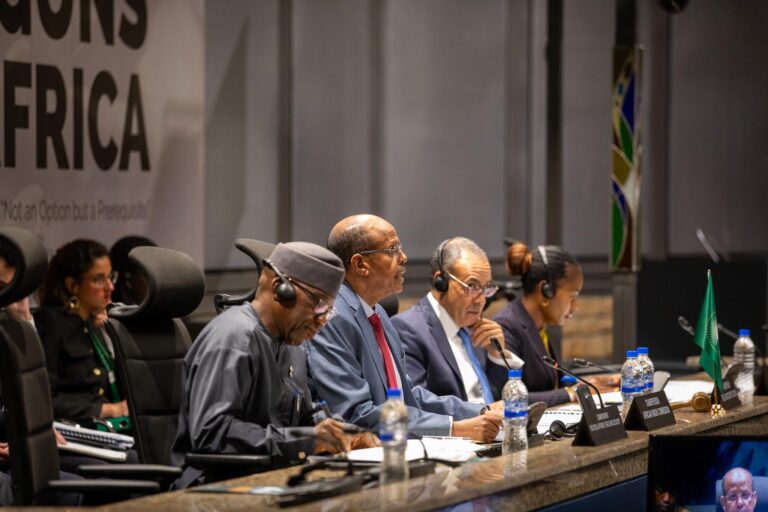
Most recently, on 12 February 2026, Egypt leveraged its chairmanship of the African Union Peace and Security Council (AU PSC) to place Sudan at the forefront of the Council’s discussion.
Ethiopia’s role in Sudan’s civil war has remained ambiguous. While Addis Ababa officially maintains neutrality, both the Sudanese government and media reports have alleged that Ethiopia has ties with the UAE-backed RSF. Ethiopia’s strategic calculations are shaped by concerns over Egypt’s expanding regional influence in Sudan, South Sudan, Eritrea, Somalia, and Djibouti; a move Addis Ababa considers an attempt to encircle and exert influence over the Grand Renaissance Dam dispute. Eritrea’s open alignment with the SAF and deteriorating relations with Ethiopia look further to push Addis Ababa closer to the RSF–UAE axis. Reflecting this on an X post on 12 February 2026, Getachew Reda, the Prime Minister’s advisor on East African Affairs, argued that Ethiopia “will not be a passive bystander in a region defined by intense geopolitical competition,” a diplomatic acknowledgment of Ethiopia’s involvement in the Sudanese conflict.
However, Ethiopia’s position is also influenced by internal political dynamics, particularly the tense relationship between the central government and the Tigray People’s Liberation Front (TPLF). During the war in the Northern part of the country, Ethiopia accused SAF of supporting Tigrayan forces, a claim reinforced by reports of SAF’s recruitment of fighters from the Tigray Defense Forces/TDF and Tigrayan refugees in Sudan. These allegations might also have shaped Ethiopia’s role in the Sudanese conflict.
Russia and Turkey have emerged as influential, but fluid, external actors in Sudan’s civil war, with their involvement shaped by shifting geopolitical calculations, access to strategic resources, and ambitions for regional influence. Russia initially cultivated close ties with the RSF through the Wagner Group; more recently, however, Moscow has recalibrated toward the SAF, prioritizing long-term strategic gains such as securing naval access on the Red Sea. Turkey’s engagement follows a different trajectory but similarly reflects strategic ambition. Ankara has provided military technology, including drones, and diplomatic backing largely to SAF and Islamist-leaning factions, viewing Sudan as a key node in its broader Red Sea and HoA strategy.
In conclusion, the involvement of diverse foreign actors has added a complex layer to Sudan’s civil war, further deepening the militarization of rival actors in the conflict. This has transformed the country into a proxy arena for broader regional rivalries. Hence, the conflict in Sudan demonstrates that strategic competition among Middle Eastern powers across the Red Sea and the HoA has intensified local conflicts, transforming what might have remained limited power struggles into protracted warfare, further undermining prospects for silencing the guns and achieving democratic gains.
1 thought on “Geopolitics in Motion: External Interventions in the Horn of Africa and the Escalation of Conflict in Sudan”
Leave a Reply Cancel reply
Related Content
Towards Democratic Hybridity in the Horn of Africa
Towards Democratic Hybridity in the Horn of Africa This piece is published under the platform of HCD’s Horn Policy Reference...
The Role of Civil Political Actors in Shaping the Outcome of the War and Charting the Post War Democratization in Sudan
The Role of Civil Political Actors in Shaping the Outcome of the War and Charting the Post War Democratization in...
Reimaging Democracy: Beyond Winners and Losers
Reimaging Democracy: Beyond Winners and Losers This piece is published under the platform of HCD’s Horn Policy Reference Group, established...
The Horn of Africa and the US-Israel-Iran War: An Opportunity for a Strategic Reset?
The Horn of Africa and the US-Israel-Iran War: An Opportunity for a Strategic Reset? This piece is published under the...
Sudan’s War as a Turning Point: The Decline of Military Power and the Reordering of State–Society Relations
Sudan’s War as a Turning Point: The Decline of Military Power and the Reordering of State–Society Relations The military, specifically...
Geopolitics in Motion: External Interventions in the Horn of Africa and the Escalation of Conflict in Sudan
Geopolitics in Motion: External Interventions in the Horn of Africa (HoA) and the Escalation of Conflict in Sudan The Horn...
[…] control over the Sudanese state.The ongoing conflict that has been sustained with significant foreign support has undermined the internal cohesion and territorial integrity of the Sudanese state, bearing […]