Women at the Peace Table in Sudan and South Sudan

As part of its ongoing project to promote women’s participation in mediation processes in the Horn of Africa, HCD, in partnership with the Agency for Peacebuilding (AP) and the Muslim Women Advancement of Rights and Protection (MWARP), hosted the third webinar in its series titled “Women at the Peace Table: Regional Learning, Solidarity, and Advocacy in the Horn of Africa.” The virtual session took place on April 1, 2026, bringing together peace practitioners, regional experts, and civil society actors to examine opportunities and challenges for women in ongoing peace processes.
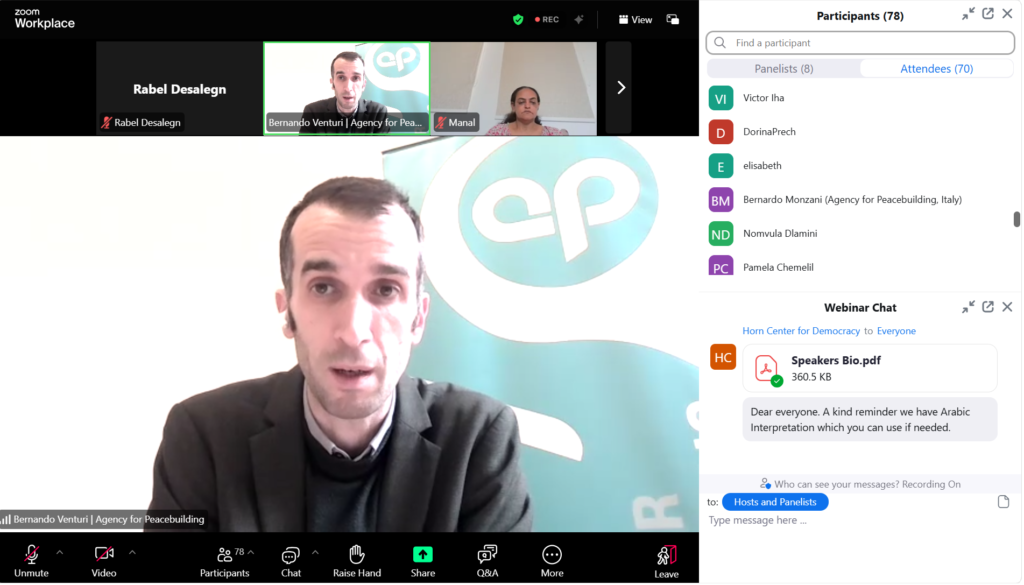
Bernardo Venturi, President and Head of Policy and Research at AP, moderated the session, while Yemisrach Kebede, Program and Partnerships Director at HCD, opened the webinar by highlighting the critical importance of women’s meaningful participation in shaping sustainable peace.
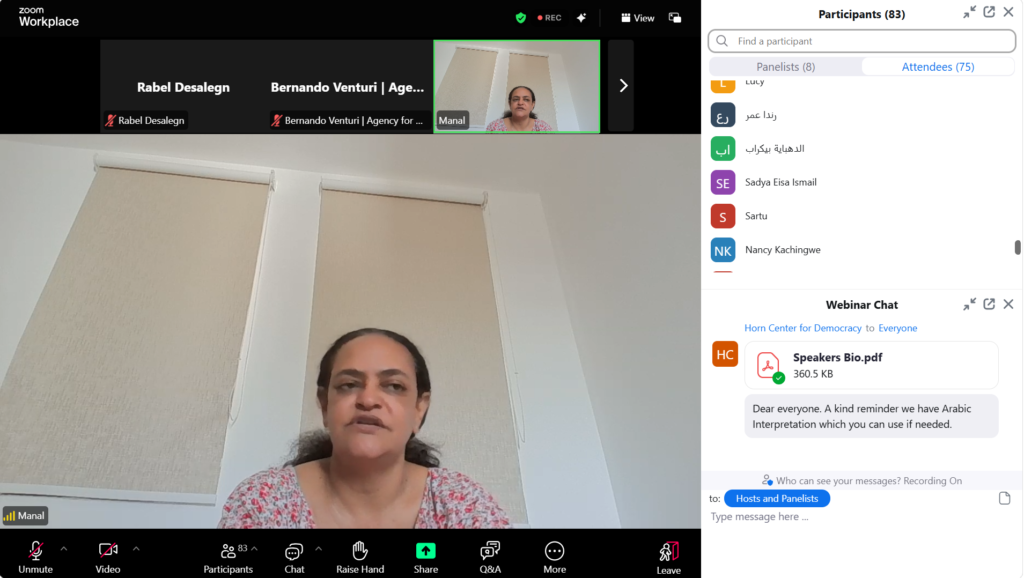
The panel featured high-profile experts, including Rita Lopidia, South Sudanese peace and security expert; Manal Taha, Sudanese peace and mediation expert and member of HCD’s Policy Analysis Group (PAG); and Dr. Rabab Baldo, former Senior Gender and Inclusivity Advisor at the Office of IGAD.
Panelists reflected on current political and conflict dynamics in Sudan and South Sudan, assessing the constraints and opportunities for women’s engagement in regional and national peace processes. They shared lessons on collaboration with regional actors and discussed practical strategies to enhance women’s roles in mediation and peacebuilding.
Rita Lopidia highlighted the experience in South Sudan, noting that despite the initial promise of the revitalized peace agreement between Riek Machar and Salva Kiir, women struggled to secure meaningful representation. She emphasized that women were often marginalized through allegations of being “underdogs” or “spies of Western countries,” and that both the number and nature of delegates significantly influenced the effectiveness of women’s participation.
Addressing Sudan, Manal Taha pointed out that conflict remains deeply entrenched, driven by political power struggles and resource competition. She stressed that peace processes must be trauma-informed and prioritize healing, achievable only through active inclusion of women at all levels.
Dr. Rabab Baldo critiqued traditional, process-oriented approaches, advocating instead for people-centered peace mechanisms that move beyond power-sharing to address societal needs and ensure women’s inclusion.
The webinar concluded with a discussion on the specific targets for women’s engagement in peacebuilding. Panelists emphasized that women’s participation is essential not only in shaping outcomes but throughout the process itself. They highlighted the demographic significance of women and the disproportionate impact of conflict on them, arguing that sustainable peace cannot be achieved without their meaningful inclusion at every stage.
HCD’s webinar series continues to create spaces for regional learning, advocacy, and solidarity, strengthening women’s participation in peace processes across the Horn of Africa.