
Sudan’s War as a Turning Point: The Decline of Military Power and the Reordering of State–Society Relations
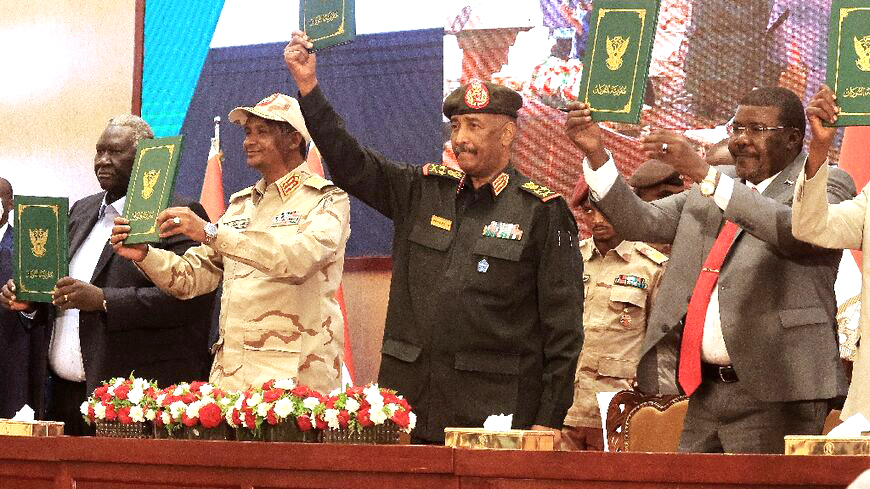
The military, specifically the Sudan Armed Forces, has long functioned as a central political institution in Sudan, viewing itself as the guardian of the state and consequently intervening repeatedly in governance, most notably through recurrent coups. Acting independently, and at times in coordination with co‑opted inner members of civilian authorities, non‑governing political parties and civilian movements the military obstructed civilian administrations and intervened in politics. This article examines the interventionist role of the military in political life, analyzes how the ongoing conflict has eroded traditional power asymmetries among the warring parties, and explores how these dynamics are reshaping state–society relations.
Context
Since its establishment as the Sudan Defense Force (SDF) in 1925 under British colonial rule, the Sudanese Armed Forces (SAF) have undergone multiple phases that profoundly shaped its relationship with the domestic political actors. Its pre-independence era experience has helped SAF to develop a distinct class-consciousness earlier than any other segment of Sudanese society. This has contributed to the evolution of a Sudanese version of a “garrison state” where soldiers and generals occupied central roles in governance and administration. This blurred boundary between military-cum-civilian authority repeatedly undermined democratic transitions and were a major threat to regimes in Sudan for coups and mutiny.
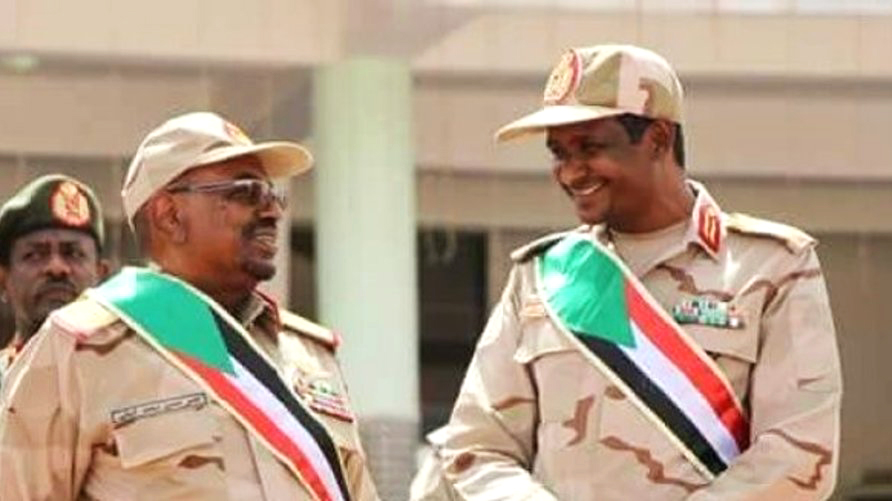
In the later years of his rule, General Omar al-Bashir, while he himself came to power with SAF support, deliberately introduced rival security and military institutions to dilute the SAF’s dominance and decrease its significance. These included the National Intelligence and Security Service (NISS) and the People’s Defense Force (PDF). To further safeguard his regime against coups and popular uprisings, Al-Bashir elevated tribal militias in western Sudan and allies in the war in Darfur, Janjaweed, into formalized units as Border Guards and later the Rapid Support Forces (RSF). In 2013, constitutional amendments granted the RSF legal impunity, enabling its transformation from localized tribal militias into a central political contender in Khartoum. In doing so, Al-Bashir sowed the seeds of Sudan’s ongoing civil war, albite for short-term political gains affecting long-term stability of the country.
General Omar al-Bashir […] deliberately introduced rival security and military institutions to dilute the SAF’s dominance and decrease its significance.
A Fractured Military
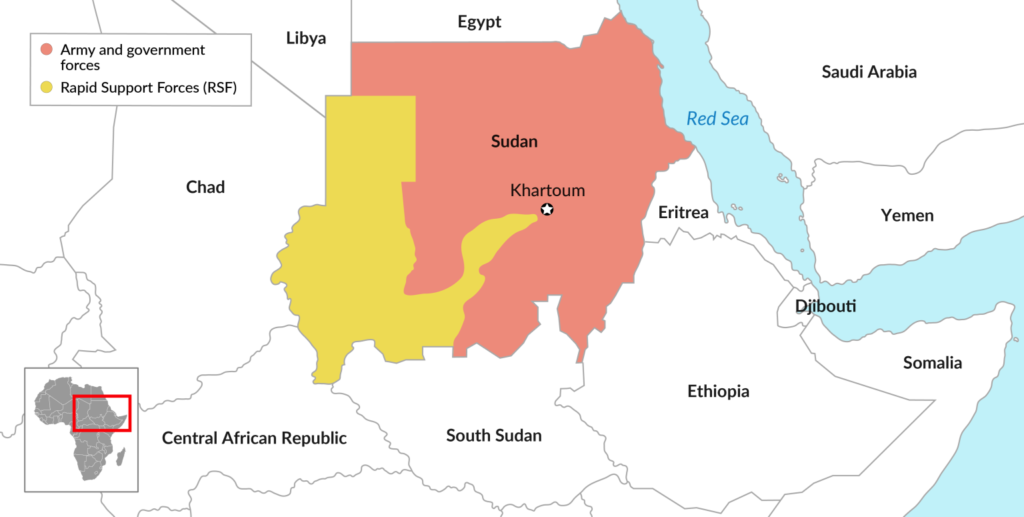
Today, Sudan is engulfed in an intra-governmental war of unprecedented scale, marked by widespread destruction, mass displacement, and staggering loss of life surpassing even the violence associated with South Sudan’s independence. On the battlefield, the SAF and RSF, respectively represented by General al-Burhan and General Hemetti, continue to escalate their campaigns through ground offensives, artillery strikes, drone operations, and aerial bombardments, yet neither has achieved decisive control over the Sudanese state.
The ongoing conflict that has been sustained with significant foreign support has undermined the internal cohesion and territorial integrity of the Sudanese state, bearing alarming similarities of fragmentation witnessed in Libya, Yemen, and Somalia. Sudan now divided between two parallel governments: the RSF- and SPLM-N/AH-backing Tasis administration in Darfur and parts of Kordofan, and the SAF and its allies running Transitional Sovereignty Council (TSC) in eastern and central Sudan. This division has deepened societal fractures, replacing the historic North-South divide with a new Center-West polarization.
Despite the devastation, the conflict has also introduced potential positive developments for Sudanese politics in the long term. The fluctuating power relations and the resulting stalemate between SAF and RSF increases the likelihood that mediation and negotiation will become the only viable path to end the war. Moreover, the war is reshaping state-society relations, particularly military-society relations, in ways that may empower civilian political actors. Curtailing the military’s entrenched role in politics this shift could lay the foundation for a genuine democratic transition in Sudan dominated by civilians.
Crisis as an Opportunity
The democratization process in Sudan has long been impeded not only by ineffective leadership and fragile institutions but also by entrenched asymmetries in power relations between the state and society. At the heart of this imbalance lies the coercive dominance of the SAF, whose overwhelming strength has consistently obstructed the country’s transition toward democratic governance. Although the military aligned itself with civilian protestors during pivotal national crises in October 1964, April 1985, and April 2019 against un-democratic regimes of Abboud (1958–1964), Numeiri (1969–1985), and Omar al-Bashir (1993–2019) respectively, it has also remained the principal force undermining democratization efforts.
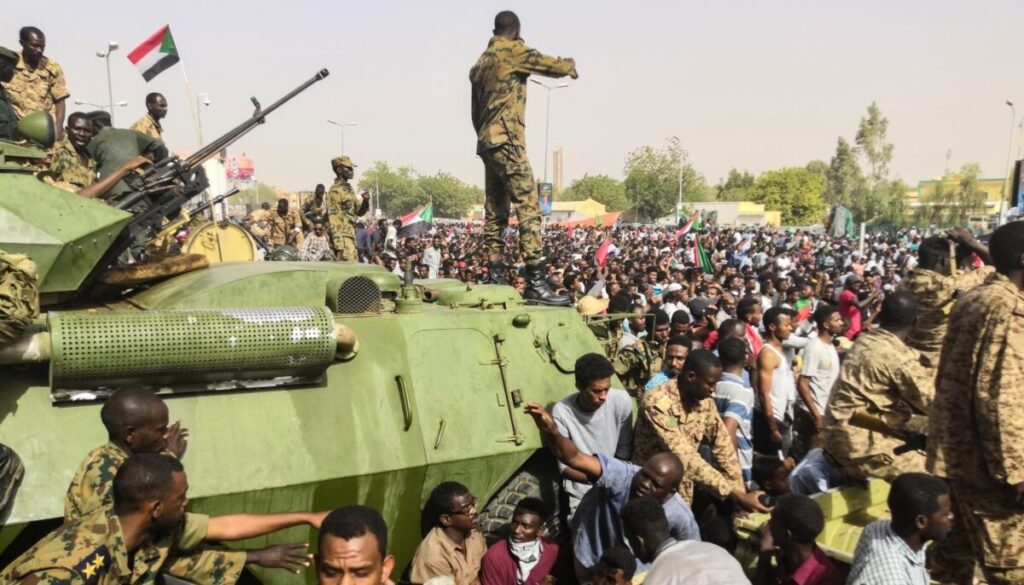
[…] the military aligned itself with civilian protestors during pivotal national crises […] it has also remained the principal force undermining democratization efforts.
Invoking a paternalistic sense of guardianship and a self-proclaimed mandate to “protect the nation”, the SAF repeatedly staged coups and mutinies against both elected and civilian transitional governments, thereby eroding civilian authority and hijacking the democratic process. In November 1958, the military thwarted the establishment of post-independence civilian governance and subsequently intervened in the overthrow of civilian-led administrations, including Ismail al-Azhari (1965–1969), Sadiq al-Mahdi (1986–1989), and Abdalla Hamdok (2019–2021), through coups carried out in May 1969, June 1989, and October 2021, respectively. By exploiting its coercive capacity and capitalizing on the relative weakness of civil society, the military deterred civilian politicians from asserting dominance in Sudanese politics.
This moment may catalyze a broader societal reflexivity, prompting a reimagining of the political sphere. Prior to the current civil war, many Sudanese accepted the SAF’s self-conception as the guardian of the state. Yet, as policymakers and mediators continue to frame the conflict in terms of which of the two generals represents the “lesser evil,” both the SAF and the RSF have been implicated in atrocity crimes. This recognition could open a new horizon of political possibilities for civilian actors, despite their present fragmentation and organizational weakness.
SAF’s historic legacy of political intervention has been significantly eroded since the outbreak of the civil war in April 2023. A combination of factors including the declining balance of power between warring parties, the fragmentation of foreign support once monopolized by the SAF, and the growing economic influence of the RSF, particularly in gold mining and trade has weakened the military’s traditional supremacy over war activities, diplomacy and economy. Before the war, SAF controlled nearly 80% of Sudan’s economy through more than 400 affiliated enterprises. Today, however, its fiscal health has deteriorated, foreign backing has diminished, and its coercive capacity has been compromised. Crucially, SAF will no longer holds a monopoly over the means of violence, casting doubt on its future role in regime change, suppression of civilian movements, and the making or breaking of governments.
SAF will no longer holds a monopoly over the means of violence, casting doubt on its future role in […] the making or breaking of governments.
The ongoing conflict has further exposed the limitations of the SAF. Despite its vast arsenal of conventional weaponry, the military has struggled to counter the RSF’s insurgent strategies and growing political significance. The war has strained its logistical capacities, overstretched its battlefronts, and drained its deployable forces. In contrast, the RSF has consolidated its command structure, established a war economy rooted in revenues from mining in Western Sudan, and supplemented its resources with arms seized from the SAF. By balancing external assistance with internally generated revenues, the RSF has emerged as a formidable contender for political and military dominance, significantly eroding the SAF’s influence across political, economic, and military domains.
The war is […] gradually rebalancing state-society relations in favor of civilian actors by questioning the historically entrenched political norm of the military
Paradoxically, while the confrontation between the SAF and RSF is catastrophic resulting in immense human loss, material destruction, and threats to Sudan’s territorial integrity, it also carries potential positive implications for Sudan’s democratic future. The conflict is weakening the historical legitimacy of SAF and undermining its claim to act as the nation’s ultimate security provider. The war has downgraded the military into an existential threat, creating a profound disjuncture between its self-perception as the savior of the state. As the war continues, the SAF’s ability to dictate Sudan’s political trajectory is diminishing, gradually rebalancing state-society relations in favor of civilian actors by questioning the historically entrenched political norm of the military as a major political institution and power broker. The decline of military coercive strength reduces its capacity to enforce authoritarian tendencies and obstruct pro-democracy movements, thereby creating space for civilian organizations to assert greater influence in negotiations. In the aftermath of the conflict, a weakened and fractured military may lose its ability to dominate governance, offering an unprecedented opportunity for civilian actors to strengthen their bargaining power and advance democratic reforms. In this sense, the very conflict that threatens Sudan’s survival may also serve as a catalyst for genuine democratization and a transition to civilian rule.
The international community should seize this moment and intensify its engagement with Sudanese civilian political forces, granting them a more prominent role in mediation and negotiation processes to help steer Sudan’s political future toward democratization.
Related Content
Sudan’s War as a Turning Point: The Decline of Military Power and the Reordering of State–Society Relations
Sudan’s War as a Turning Point: The Decline of Military Power and the Reordering of State–Society Relations The military, specifically...
Geopolitics in Motion: External Interventions in the Horn of Africa and the Escalation of Conflict in Sudan
Geopolitics in Motion: External Interventions in the Horn of Africa (HoA) and the Escalation of Conflict in Sudan The Horn...
Israel’s Recognition of Somaliland as an Independent State: Key Lessons and Regional Implications
Israel’s Recognition of Somaliland as an Independent State: Key Lessons and Regional Implications IntroductionBeyond the wars, conflicts, insecurity, famine, and...
Eritrea’s Withdrawal from the Inter-Governmental Authority for Development: Implications on Bilateral Relations and Multilateral Arrangements
Eritrea’s Withdrawal from the Inter-Governmental Authority for Development: Implications on Bilateral Relations and Multilateral Arrangements Since gaining its independence in...