

The Horn of Africa and the US-Israel-Iran War: An Opportunity for a Strategic Reset?
This piece is published under the platform of HCD’s Horn Policy Reference Group, established to catalyze policy conversation on pertinent regional issues by renowned experts from the HoA.
The war between the Islamic Republic of Iran, the US, and Israel has produced significant impacts on the Horn of Africa region. Most analyses have focused on the war’s economic and humanitarian implications, as well as the risks of direct and indirect conflict spillover into the Horn. The consequences for democratic politics across the region have been less well-understood. The dearth of conversation in this area reflects the unfortunate erosion of democracy in the Horn of Africa. Strongmen reign supreme in the Horn; the region’s metastasizing armed conflicts have come to dominate all policymaking attention; and global norms around democracy and rule of law are under withering ideological attack.
But stability and prosperity in the Horn will eventually require advancing a democratic project. Unlike West Africa, which has experienced leadership transitions via the ballot box, democracy in the Horn has never been given an opportunity at scale. Kenya and Somaliland are modest exceptions. Authoritarian governance, meanwhile, has a long and highly questionable track record across the region, consistently failing to deliver peace and/or sustainable development. At some point, the countries of the Horn will need to respond to this lesson of history, reimagine governance, and embrace locally-rooted, open, consensus-based politics that can transform their societies and economies. The Iran War could provide such an opportunity.
While the interventions of Middle Eastern states across the Horn have been important inhibitors of democratic change, the current moment is a particularly stark illustration of the risks to the Horn of allowing itself to become entangled in the conflicts of a neighboring region. Now is as good a time as any for stakeholders across the region—its leaders, but perhaps more importantly, its civic publics—to interrogate the logics that have left them vulnerable to Middle Eastern influence, thereby charting a new course toward strategic autonomy and opening the door to meaningful democratic reform.
The Middle Eastern Sources of Democratic Retreat in the Horn
The Horn’s current democratic deficit is closely linked to the expanding strategic footprint of Middle Eastern states into the Horn over the last decade. This is not to externalize the problem of democratic institution-building across the region, as the challenge is long-running and primarily homegrown. But the “Horn Spring” of 2018-2019 saw civic resistance topple long-running autocratic orders in the region’s two largest states—Ethiopia and Sudan—and constituted a once-in-a-generation opportunity to seed new democratic structures. That this did not occur has much to do with the collective role played by the Gulf states, Turkey, Egypt, Israel, and Iran.
The Horn’s current democratic deficit is closely linked to the expanding strategic footprint of Middle Eastern states
There are multiple mechanisms through which democracy-eroding impacts have been transmitted. In search of commercial opportunities and strategic allies, Middle Eastern governments have provided the military and financial tools for state and non-state actors in the Horn to pursue their interests through violence. The resulting militarization of politics has profoundly narrowed the scope for democratic practice and institutions. In Sudan, for instance, some civil society elements have been coercively targeted by the warring parties and/or felt compelled to take sides in the country’s war. In Ethiopia and Somalia, democratic processes have sometimes been complicated by insecurity and/or rivalry between central and sub-national authorities.
The other corrosive impact on democratic politics in the Horn is more subtle but no less consequential. Diplomatic approaches often reflect domestic structures of authority. So it’s no surprise that the princely and strongman states of the Middle East privilege their ideological fellow travelers in the Horn. The resulting tendency has been to support—politically, economically, and militarily— authoritarian political structures across the Horn, at the expense of democratic institutions and civic actors. The opaque and informal nature of resource flows between Middle Eastern capitals and the Horn’s political elite compounds this problem, rendering networks of support hard to track.
However, it is important to note that the above patterns are not uniform across the region. The geopolitical merging of the Horn and broader Middle East has been felt and perceived in myriad ways across and within Horn countries, creating differential risks and opportunities and a diverse array of winners and losers. Some across the Horn—including local communities and business interests—see enormous economic upside to Gulf and Turkish investment. But the broad conclusion that extra-regional intervention has been problematic for the Horn at the macro level—both for regional stability and democracy—is widely acknowledged and not particularly controversial.
Spillover Risks
Many of the major intra-Middle East geopolitical ruptures of the last 15 years have had destabilizing spillovers in the Horn: the Arab Spring, the Yemen War, the Gulf Crisis, and the Gaza conflict. The Iran War could be no different. Aside from the immediate economic and humanitarian impacts, the Iran War carries real strategic risks for the Horn. Perhaps most significant is the potential for it to further incentivize Middle Eastern powers to scale up their destabilizing competition across the Horn and Red Sea, further bolstering proxy dynamics, conflict, and their attendant consequences.
Aside from the immediate economic and humanitarian impacts, the Iran War carries real strategic risks for the Horn
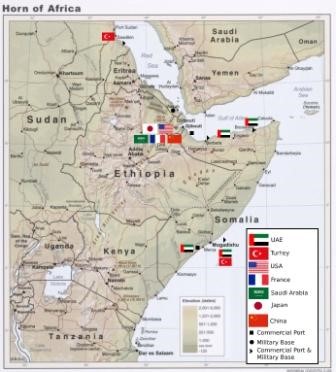
The war has already deepened existing fissures in the region between an Abraham Accords bloc composed of the UAE and Israel and a countervailing alignment comprising the Kingdom of Saudi Arabia (KSA), Egypt, Turkey, and Qatar. In January 2026, just weeks before the Iran War broke out, this faultline had threatened to erupt over divergent approaches to southern Yemen, Sudan’s civil war, and Israeli recognition of Somaliland. KSA in particular had begun to more aggressively counter-balance Abu Dhabi’s influence on its southwest flank, after years of warily tolerating growing Emirati maneuvering in the southern Red Sea.
Vulnerability of Strait of Hormuz has also increased the strategic value of the Horn of Africa littoral and Red Sea
The now-apparent vulnerability of the Strait of Hormuz has also increased the strategic value of the Horn of Africa littoral and the Red Sea to key Middle Eastern states. KSA routed a large portion of its oil production through its Red Sea Port of Yanbu in an effort to circumvent Iran’s blockade of Hormuz. For countries like the UAE and Qatar, access to Red Sea ports may provide critical strategic depth for now-exposed naval and aerial assets. More generally, the war has taught many Middle Eastern governments that they cannot allow their competitors to establish unchecked strategic leverage in and around the region’s key maritime chokepoints. Iran, for its part, retains the Houthi card and has come to understand that its ability to project coercive power into Hormuz and the Red Sea—using missiles and cheap drones— is among the most effective forms of deterrence and compellence in its arsenal. None of these logics augur well for the Horn of Africa or the cause of democracy.
A Watershed Moment?
Yet perhaps the current moment may offer a silver lining. Even before the Iran war, it was clear that competing Middle Eastern interventions in the Horn had effectively canceled each other out, producing a stalemated regional landscape that fell well short of the ambitions of the Horn’s key actors and their respective patrons. The Sudan civil war sits at a military impasse; Ethiopia’s internal conflicts have repeatedly proven difficult to resolve by force; destabilizing elite fragmentation in Somalia continues with no prospect of any particular faction achieving dominance; and the region’s interstate rivalries—with escalating tensions between Ethiopia, Eritrea, and Sudan at the center—appear to lack any apparent endgame. These facts have led to recognition across the Horn’s various power centers that years of instrumentalizing Middle Eastern rivalries have left them in a strategic cul-de-sac.
The Iran war has also demonstrated that the Horn’s Middle Eastern alliances are far from reliable.
The Iran war has also demonstrated that the Horn’s Middle Eastern alliances are far from reliable. The fuel, fertilizer, and commercial aviation links that the Gulf states provided to the Horn quickly disappeared during the conflict. There are reports that the UAE has pulled out of a $500 million humanitarian pledge to Sudan, citing budgetary pressures created by the war. And the ability of the Gulf states to provide long-term investment to the Horn across a variety of sectors is also now in question, as the Gulf reorients capital toward infrastructure projects in energy and ports that will allow it to bypass Hormuz—see, for example, the UAE’s plans for expanded pipelines and ports in its eastern regions.
These reliability concerns also extend to the security sphere. The Gulf states, in many respects, performed well during the war, shooting down a large majority of projectiles targeting their territory. But Iran was able to inflict considerable damage on its neighbors, as Gulf capitals were unable to deter or suppress attacks or restrain the conduct of the American partner that had made them a target. From the perspective of the Horn, the entire chapter raises obvious questions, chief among them: in a moment of crisis, can Middle Eastern allies actually be relied upon to provide protection? Or have these states seemingly offered security guarantees to their partners in the Horn that cannot reasonably be enforced?
A Strategic Reset?
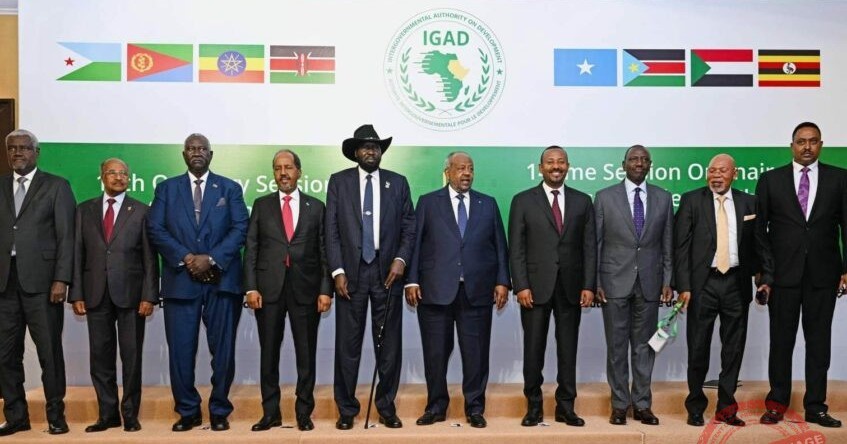
Photo: PPU/facebook
Against this backdrop, the Iran war may provide an opportunity for political actors across the Horn to rethink their dependencies and pursue a strategic reset. While disengagement from Middle Eastern partnerships is neither desirable nor realistic for countries in the Horn, a quiet consensus is emerging that the status quo is not working and that strategic autonomy is a far better alternative. Governments in the region should convene under the auspices of the AU, IGAD, and other regional mechanisms to discuss shared approaches to rebuilding strategic autonomy, which may require cooperation on supply chain resilience, limiting foreign military activity, and reinvigorating African mediation on regional conflicts.
The Iran war may provide an opportunity for political actors across the Horn to rethink their dependencies and pursue a strategic reset
Civil society might also play a role. Given how damaging external interference has been to democratic projects across the Horn, civic organizations and networks would be wise to raise awareness of the dangers posed by the status quo and help foster solution-oriented dialogue to enhance the autonomy of the Horn’s states vis-à-vis the Middle East Given the constraints on civic space across the Horn, this will be a difficult task, although in some contexts, such as Kenya civil society actors have fostered significant debate about their government’s approach to the Middle East.
The alternative is for the Horn of Africa—its governments, key political actors, and peoples—to stay the course. Regional stability and democracy will invariably continue to suffer as long as the status quo remains.
3 thoughts on “The Horn of Africa and the US-Israel-Iran War: An Opportunity for a Strategic Reset?”
Leave a Reply Cancel reply
Related Content
The Role of Civil Political Actors in Shaping the Outcome of the War and Charting the Post War Democratization in Sudan
The Role of Civil Political Actors in Shaping the Outcome of the War and Charting the Post War Democratization in...
Reimaging Democracy: Beyond Winners and Losers
Reimaging Democracy: Beyond Winners and Losers This piece is published under the platform of HCD’s Horn Policy Reference Group, established...
The Horn of Africa and the US-Israel-Iran War: An Opportunity for a Strategic Reset?
The Horn of Africa and the US-Israel-Iran War: An Opportunity for a Strategic Reset? This piece is published under the...
Sudan’s War as a Turning Point: The Decline of Military Power and the Reordering of State–Society Relations
Sudan’s War as a Turning Point: The Decline of Military Power and the Reordering of State–Society Relations The military, specifically...
Geopolitics in Motion: External Interventions in the Horn of Africa and the Escalation of Conflict in Sudan
Geopolitics in Motion: External Interventions in the Horn of Africa (HoA) and the Escalation of Conflict in Sudan The Horn...
Israel’s Recognition of Somaliland as an Independent State: Key Lessons and Regional Implications
Israel’s Recognition of Somaliland as an Independent State: Key Lessons and Regional Implications IntroductionBeyond the wars, conflicts, insecurity, famine, and...
Published on 29, June 2026 in Horn Prospects
Authored By: Michael Woldemariam, an associate professor and PhD program coordinator at the University of Maryland, School of Public Policy.
Share this:
This is quite an insightful piece.
A few observations:
1. Diplomatic relations: Perhaps this is another area that has not received adequate analysis.
– The war has occasioned diplomatic realignments between Africa and the Middle East as well as the rest of the actors on the opposing sides of the war across the global arena.
– The rise of transactional relations between the Middle East powers and political elite in the Horn of Africa is worth a mention too. On one hand, it has guaranteed regime survival for the authoritarian regimes while on the other hand it has aggravated erosion of democratic space in the Horn.
2. The question of sustainable peace: Apart from geographical proximity, the Horn of Africa and the Middle East share a lot more attributes, which makes coordinated approaches to addressing the challenges bedeviling them inevitable. However, sustainable peace in the Horn of Africa is likely to be more elusive because:
– The engagement has perpetuated externalization of Gulf rivalries in the Horn of Africa, manifested in Middle East countries’ affinity to support rival groups, mostly non-conventional non-state actors.
– The Middle East’s involvement is the Horn is mainly driven by geostrategic and economic interests. Hardly do these interventions address the root causes of the conflicts in the Middle East.
3. Strategic reset: It is timely for a strategic reset, but are the regional bodies, the main drivers of the reset, ready?
– The regional bodies (AU and IGAD) contend with a myriad of operational and structural challenges that raise serious concerns about their institutional capacity to spearhead a coordinated engagement with the Middle East.
– The tendency by the Horn of Africa states to prioritize national over regional interests diminishes the effectiveness of the regional bodies.
– The Middle East powers have often by-passed the regional bodies, mostly with their eyes on transactional relations with the national leaders.
Factoring these issues would further enrich the article.
This is a high-quality policy blog that makes an important contribution to discussions on the Horn of Africa by connecting regional geopolitics with democracy and strategic autonomy. Its greatest strengths are its originality, timely relevance, and forward-looking policy recommendations. To increase its credibility and impact, the authors could strengthen the evidence base, provide a more balanced assessment of external engagement, include richer country-specific examples, clarify the concept of strategic autonomy, and more explicitly examine the role of the United States. With these refinements, the piece would be well positioned not only as a policy blog but also as a strong commentary suitable for publication in a regional policy journal or think tank outlet.
I am afraid the article is plaming Middle Eastern countries for issues of democracy in the Horn.